She Was Sure the Big Machine Was the Serious One. Then We Set a Small One Beside It and Pressed the Button.
We put a plug-in compressor nebulizer and a handheld mesh nebulizer on the same kitchen table to find out whether bigger really meant better, and the answer had more to do with how the mist is made than with size.
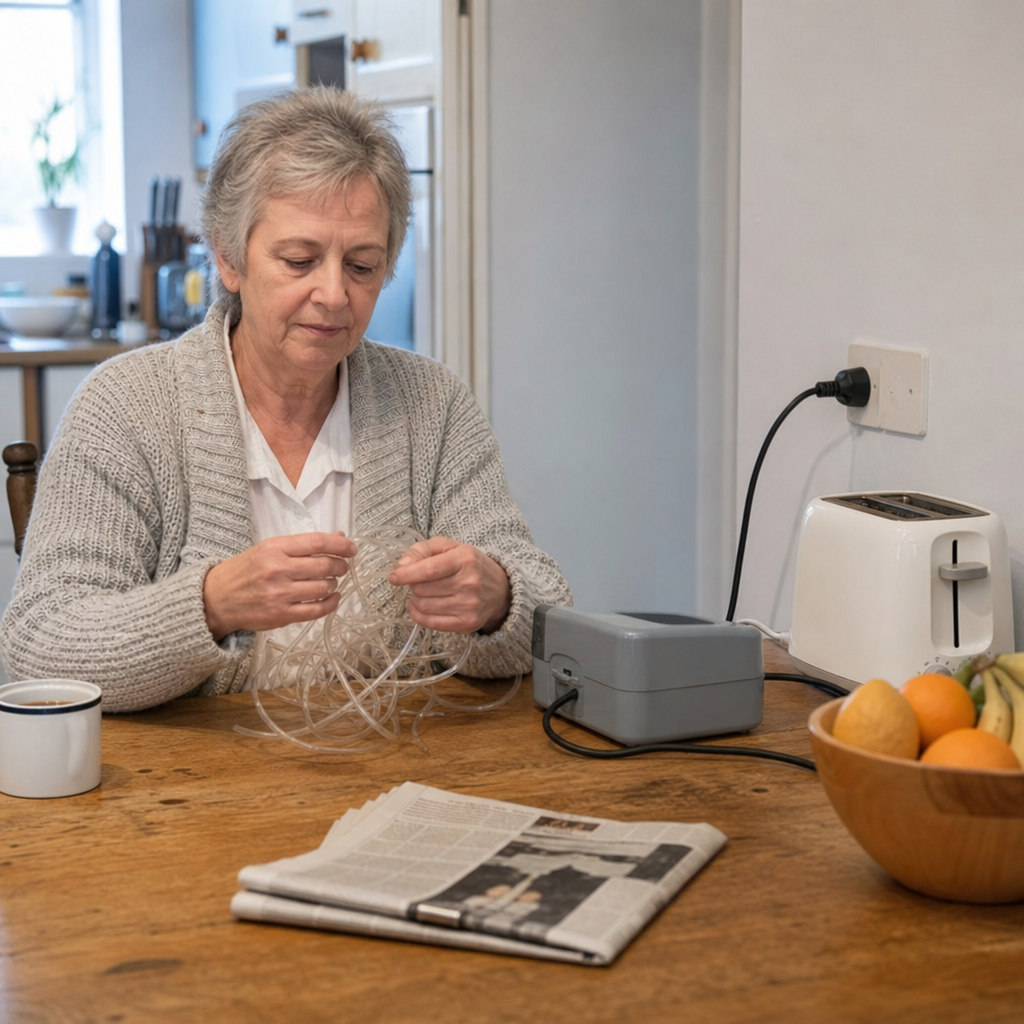
Diane had the tubing in one hand and the plug in the other when she realised the only free outlet behind the kitchen table was the toaster's.
It was ten to eight on a Tuesday. Her sister was collecting her at half past for a weekend away, and the machine still had to be set up, run, rinsed, dried and packed.
She pulled out the toaster, plugged in the compressor, and the familiar hum filled the kitchen. I sat across from her with a coffee, and we waited it out.
"Half an hour of fuss for a few minutes of breathing," she said afterwards, winding the cord around the base. "And now it needs its own bag."
Neither of us thought much more about it. That was simply what a nebulizer looked like. The big grey box was proof it was a proper one.
A week later, her sister said something on the phone that made us both wonder.
The Grey Box on the Kitchen Table Had Quietly Taken Over Her Mornings
Diane's compressor nebulizer had lived on the same corner of the kitchen table for years. It was sturdy, it was reliable, and it was never in her way until she needed it to be somewhere else.
The session itself was not the problem. Everything around it was.
The cord only reached one outlet without stretching across the floor. The tubing kinked if it was coiled too tightly. The medication cup, the mask and the tubing all had to be connected in the right order, then separated, rinsed and left to dry.
While it ran, the compressor motor hummed steadily on the table, and she stayed within reach of the cord until it was done.
When she went anywhere overnight, the whole setup went with her in a separate bag, along with the hope that the guest room had an outlet near a chair.
None of this was broken. The machine did exactly what it was built to do. It had just become something she arranged her day around.
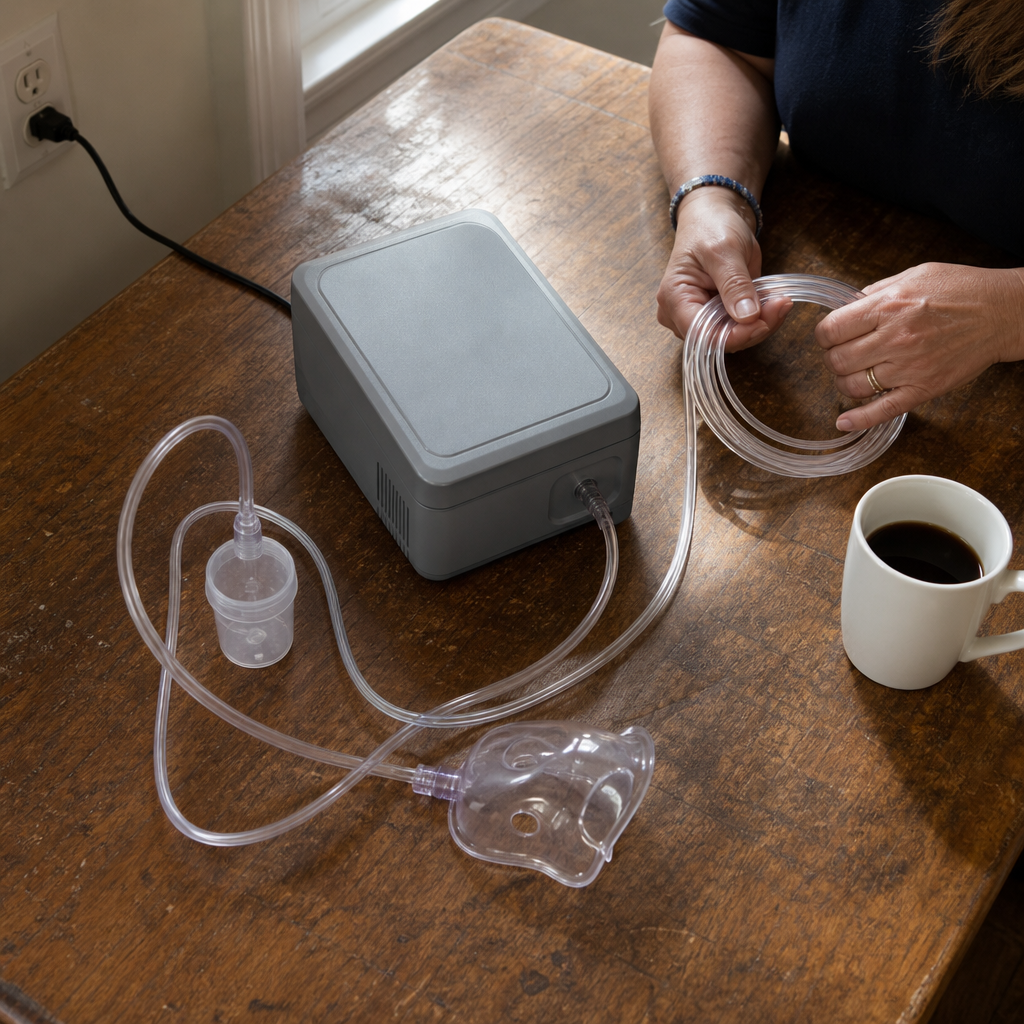
Carry the machine to the table, find a free outlet, connect the tubing, attach the medication cup and mask.
Sit within reach of the power cord while the compressor motor runs.
Disconnect everything, rinse, leave to dry and coil the tubing back up.
Pack the compressor, power cord, tubing and accessories in their own bag.
Her Sister Said Hers Fit in One Hand, and We Both Assumed She Was Missing Something
The call was on speaker. Diane's sister June mentioned, almost in passing, that she had switched to a nebulizer that fits comfortably in one hand. No compressor, no hose, nothing plugged into the wall while she used it.
Our first reaction was the same. There was no way something that small could be a practical alternative to the machine on the table.
If you have used a compressor nebulizer for a while, you are probably thinking the same thing right now.
It felt like common sense. A heavy box that hums sounds like it is working hard. Something light enough to hold in one hand sounds like a gadget.
Looking back, we were doing what most people do with machines. We were treating size and noise as a stand-in for strength.
The trouble was, when I asked Diane what the big box was actually doing that a small one could not, neither of us had an answer.
“If it fits in your hand, something has been left out. It has to have been.”
Diane, on the phone with her sister
The Size of a Nebulizer Comes Down to How It Makes the Mist
That evening I looked it up. It turns out there is more than one way to turn liquid into a breathable mist, and the method decides most of the size.
Diane's machine is a compressor nebulizer. A motor drives an air pump, the pump pushes air through the tubing into a small cup, and the moving air breaks the liquid into mist.
A mesh nebulizer works differently. The liquid sits against a thin plate dotted with very tiny holes. The plate vibrates very fast and pushes the liquid through those holes, turning it into a fine mist directly.
Here is the simplest way I found to picture it. Imagine two ways to turn a glass of water into a fine spray. You could blow hard across it through a straw, which takes a lot of breath, and in a machine that breath is a motor and a pump. Or you could press the water through a sieve with holes far finer than any kitchen sieve, shaking so fast the water comes out the other side as mist. The second way needs no breath at all.
So the big grey box was not big because a nebulizer has to be big.
Most of its size was the pump.
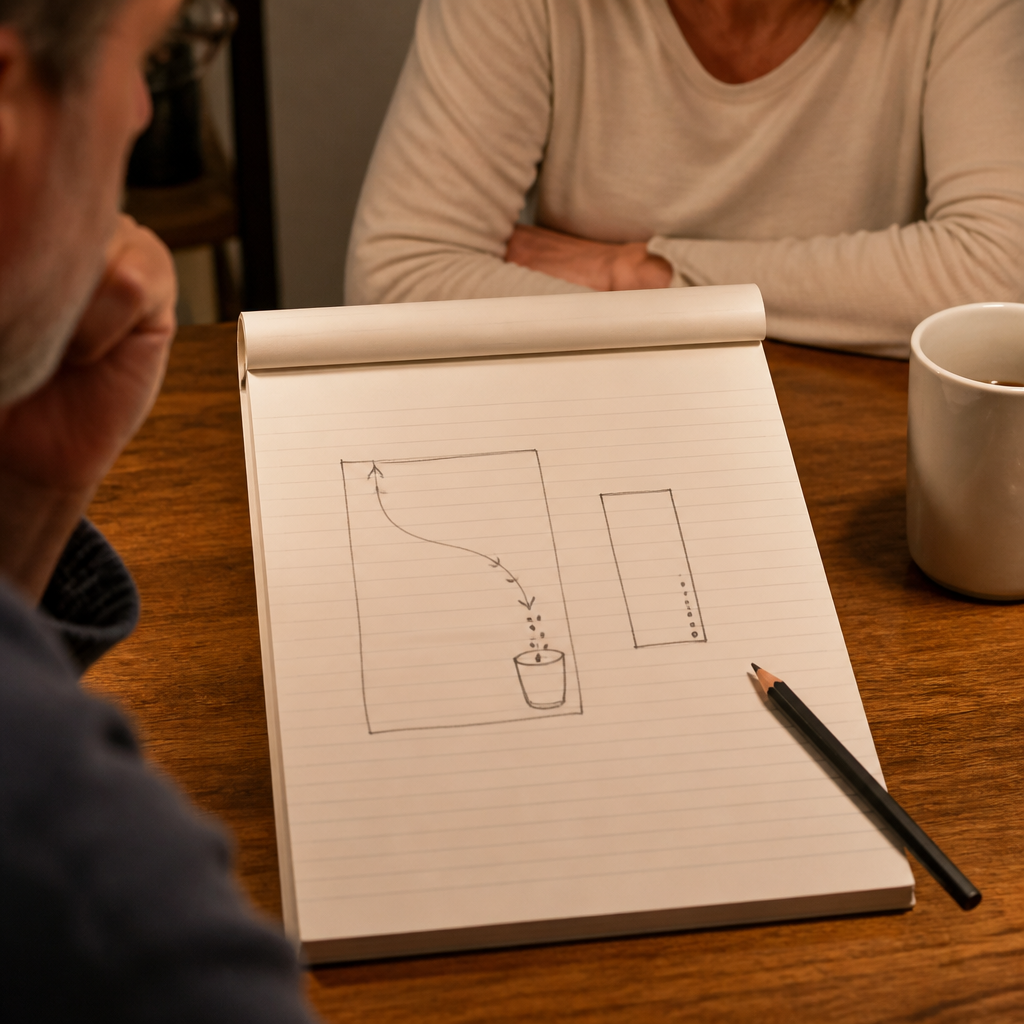
Motor and air pump, then forced air, then tubing, then medication cup, then mist.
Liquid, then a vibrating mesh with very tiny holes, then fine mist.
A motor, pump and hose in one case. A small mesh and a rechargeable battery in the other.
Nobody Had Ever Explained Why Diane's Machine Was Shaped the Way It Was
When I showed Diane the sketch, she said something that stuck with me. In all her years of using it, nobody had ever told her why her nebulizer looked the way it did.
That is not unusual. Most of us get our first machine, learn the routine, and never think about what is happening inside the box.
And the hum does a lot of persuading. When you hear a motor working, it feels like progress. Silence feels like nothing is happening.
We have seen this pattern before with other things. Computers that once filled a desk now fit in a pocket. The job did not get smaller. The way of doing it changed.
None of this makes a compressor nebulizer wrong. It does its job. It simply comes from a way of making mist that needs a pump and a hose.
Still, an explanation on a notepad is one thing. We wanted to see what the real difference was with our own eyes.
Then We Put PureBreathe Next to the Compressor and Pressed the Button
I ordered one the next morning: PureBreathe, a vibrating mesh nebulizer.
When it arrived, it fit comfortably in one hand. The body was shorter than my phone and about as wide as two fingers, with a mask roughly the size of a palm.
We set it on the kitchen table right beside the grey compressor. Next to it, PureBreathe looked almost too small to take seriously.
I filled its small cup with sterile saline, the same kind Diane already used, and attached the mask.
Diane leaned in.
Then we switched it on.
Within seconds, a fine, steady mist came out of the mask.
No motor starting up. No hose across the table. No cord to the wall.
Just a device in one hand, making mist the way the sketch said it would.
A word of honesty here. Visible mist shows the device is running. It does not indicate how effective a treatment is. Results depend on the medication, the device and the instructions from your healthcare professional.
What it did show us was simple. Small did not mean flimsy or fiddly. The surprise was not how small it was. It was how much had been fitted into something that small.
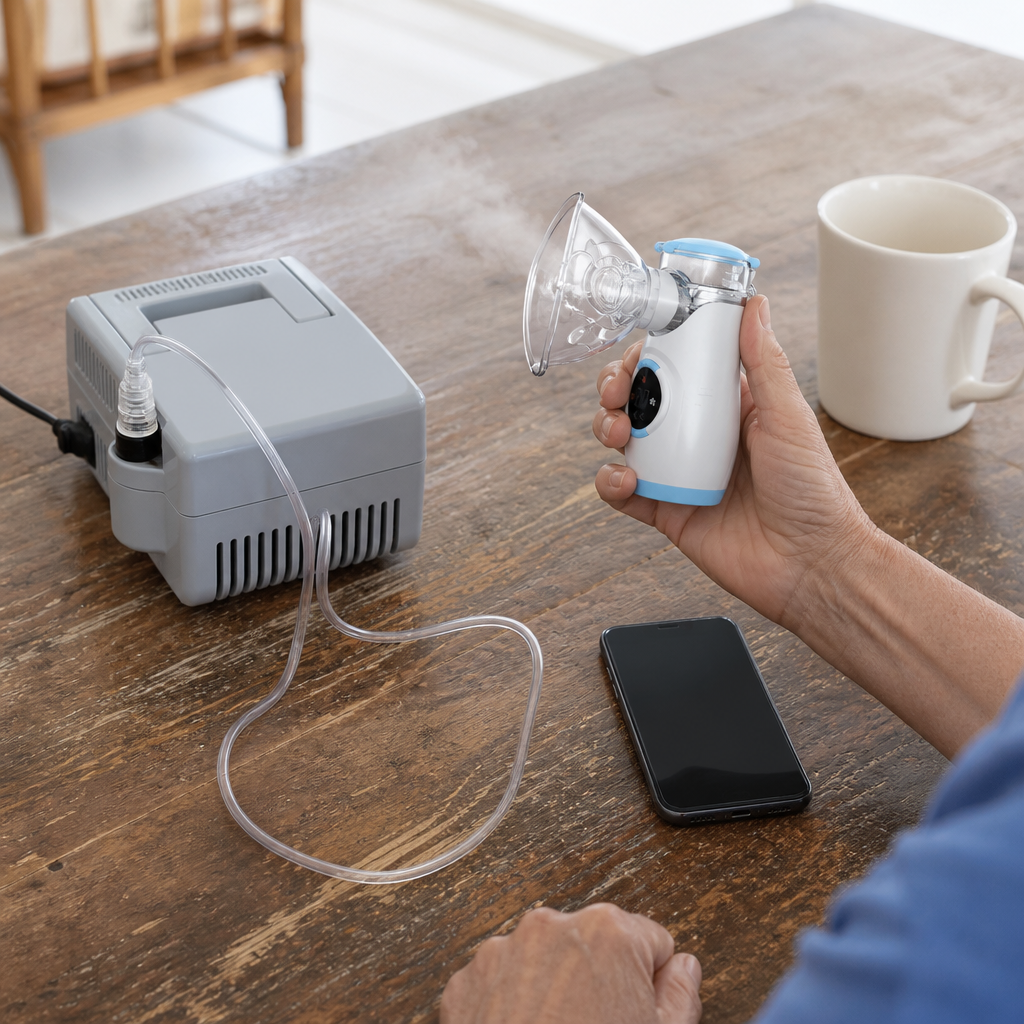
“That's the whole thing? Where's the rest of it?”
Diane, the first time she saw it running
Diane Counted Every Step of Both Routines, and the Gap Surprised Her
Once the novelty wore off, Diane did something practical. She wrote down every step of each routine, from the moment she decided to start to the moment she could breathe in the mist.
With the compressor: - Carry the machine to the table - Find a free outlet - Connect the tubing - Attach the medication cup and mask - Sit within reach of the cord while the motor runs
With PureBreathe: - Add sterile saline or the liquid medication prescribed for nebulizing to the small cup - Attach the mouthpiece or the mask - Press the button and breathe in the mist as your healthcare professional has directed
None of the compressor steps is hard on its own. Done most days, they add up.
There is also no compressor motor running during the session, because there is no compressor. Afterwards, PureBreathe is cleaned as the included instructions describe and charged by USB, ready for next time.
At Home the Bulk Was Manageable, but the Weekend Away Changed the Comparison
If a nebulizer never leaves the kitchen table, its size may not bother you much. Diane had lived with hers for years.
The real difference showed up the following Friday, when she packed for her sister's.
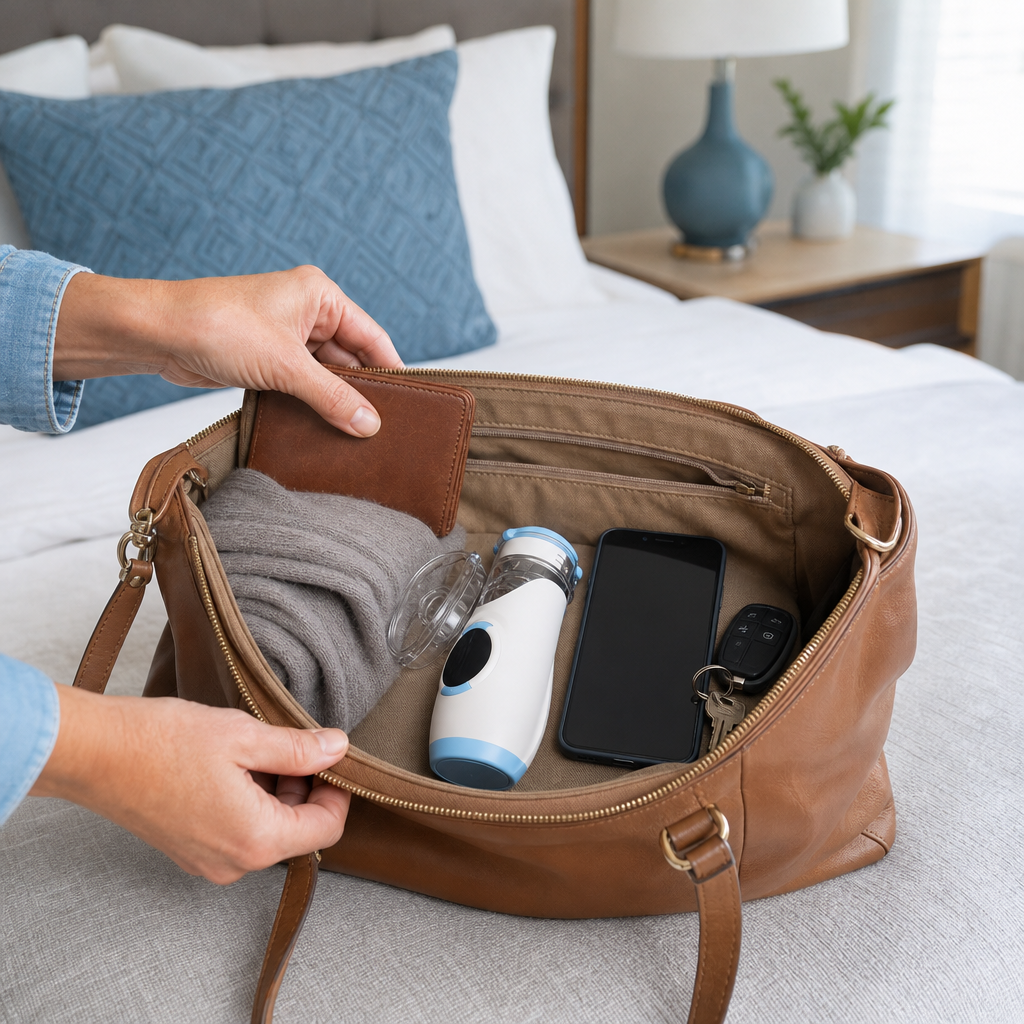
The compressor would have needed its own bag: the machine, the power cord, the tubing, the cup and the mask. PureBreathe went into her handbag next to her wallet and phone.
Because it recharges by USB and needs no wall connection during use, the question of where the outlet was simply went away.
That same ease shows up in smaller places too: - Visiting family for the weekend - A desk drawer at work - A hotel room or a carry-on - Moving from the kitchen to the sofa in the middle of the evening
The compressor works well on a table. The handheld format makes more sense when life does not happen at that table.
Diane Stopped Asking How It Could Be So Small and Started Asking Why Hers Was So Big
Before changing anything about her routine, Diane rang her doctor's office and asked. That is the step we would tell anyone to take, especially if you use prescribed medication.
After that, the change was gradual and fairly ordinary. Her sessions were the same sessions. What changed was everything around them.
The toaster stayed plugged in. The compressor moved to the hall cupboard. PureBreathe lived in the drawer by the kettle during the week and went into her handbag on Fridays.
So which one is better? We would put the question differently. This was never small against powerful. It is an older way of making mist against a newer one.
The compressor did nothing wrong. It comes from a time when making mist meant pumping air through a hose. Vibrating mesh takes the pump and the hose out of the picture, and what is left fits comfortably in one hand.
“I thought the big one was the serious one. It turns out it was just the older one.”
Diane, three weeks later
This Story May Sound Familiar If
- You are using a plug-in compressor nebulizer and have noticed how much of each session is spent on setup.
- You are tired of hunting for a free outlet and untangling tubing before you can begin.
- You are someone who takes your nebulizer to family, to work or on trips, and packs it in its own bag.
- You are curious about mesh technology but assumed anything small enough to hold in one hand had to be a compromise.
- You are happy to check with your healthcare professional before changing how you use prescribed medication.

PureBreathe is $39.97 today, down from the regular $69.97. Buy 2 and get 1 free, with free shipping and a 30-day money-back guarantee.
Check AvailabilityTry PureBreathe in your own routine. If it is not right for you, you have 30 days to return it for your money back.
Back at Diane's Kitchen Table
The grey compressor is still in Diane's hall cupboard. It still works. She just rarely reaches for it now.
On Tuesday mornings the toaster stays where it is, and a device that fits comfortably in one hand comes out of the drawer by the kettle.
You have the same choice she had. Keep arranging your day around a machine on a table, or try the version where the pump and the hose are simply gone.
If you use prescribed medication, talk to your healthcare professional first. Then ask yourself the question Diane ended up asking: why did a nebulizer ever need to be that big?
Check AvailabilityThis story is illustrative. Names and personal details have been changed, and it does not describe a specific customer. PureBreathe is for use only with sterile saline or liquid medication prescribed for nebulization. Never use oils, homemade mixtures or any substance not intended for nebulizers. Visible mist does not indicate treatment effectiveness; results depend on the medication, the device and your healthcare professional's instructions. This article is not medical advice. Do not change or stop using a device prescribed for you without speaking to your healthcare professional first.